In recent years, artificial intelligence has ceased to be something abstract and has become a real tool changing the approach to doing business. This is especially noticeable in the field of process automation, where traditional scripts and template solutions are giving way to intelligent agents — autonomous systems capable of analyzing data, making decisions, and performing tasks without constant human involvement.
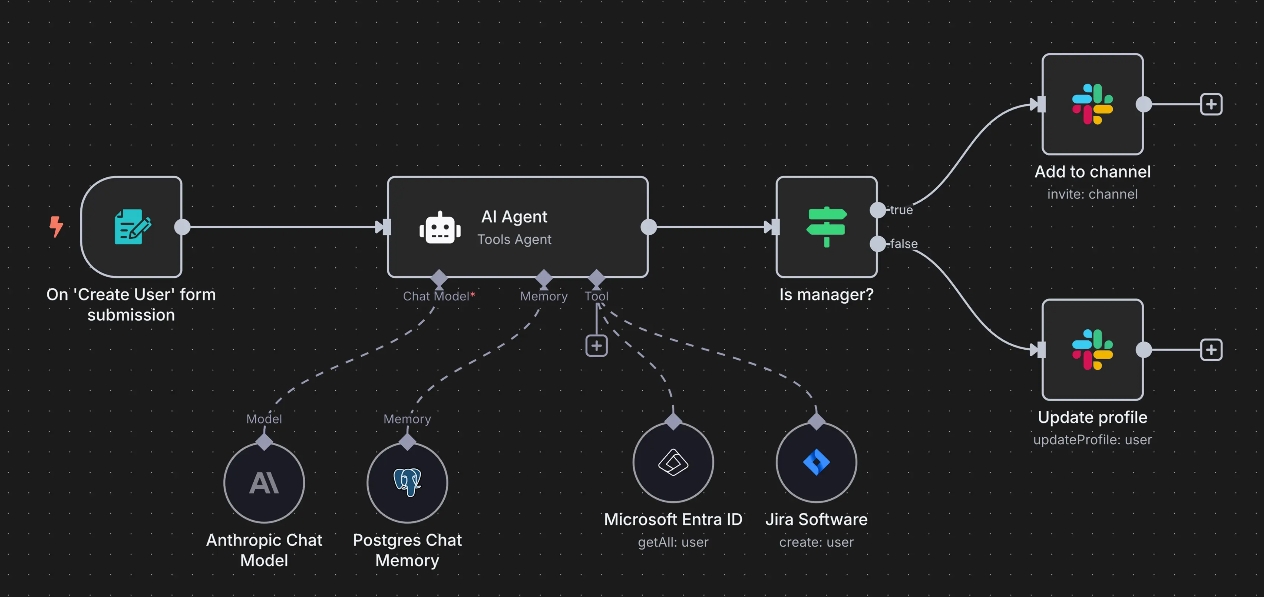
What makes AI agents so attractive to business? First and foremost, their ability to adapt to changing conditions and learn from accumulated experience. Unlike programmed systems, AI agents can handle complex scenarios, consider context, and offer optimal solutions in real time. This is particularly important in a dynamic market environment where speed and accuracy in decision-making are key success factors.
Moreover, implementing AI agents allows for significant cost reduction. Many routine tasks that previously required the involvement of several employees can now be performed automatically — for example, using no-code/low-code platforms like n8n — freeing up resources for more strategically important directions. This not only increases efficiency but also reduces the likelihood of errors related to the human factor.
Integrating AI agents into business processes requires a thoughtful approach. It is important not only to correctly build the architecture of solutions but also to ensure their stability, security, and alignment with the company’s specific tasks. At the same time, the flexibility of such systems allows them to be configured for any goals: from handling requests and customer support to working with financial documents and internal logistics.
AI agents become not just a convenient tool but the foundation of a new business culture. Where employees once spent hours on repetitive tasks, intelligent processes are now engaged. This accelerates task execution, minimizes routine, and increases operational accuracy.
Technologies are developing rapidly, and artificial intelligence has already become part of everyday business reality. Its integration is not an experiment but a necessity for companies striving to maintain competitiveness and increase efficiency.
AI agents are not the future but the present, transforming approaches to work, resources, and interaction within companies. Using such solutions opens new opportunities for growth, stability, and technological leadership.