
Cross-platform app development with Flutter and React Native
Flutter app development and React Native development from one team: a single codebase for iOS and Android ships faster and costs less than two separate native builds. We pick the technology for your project and go native on request.
from ₴33,000
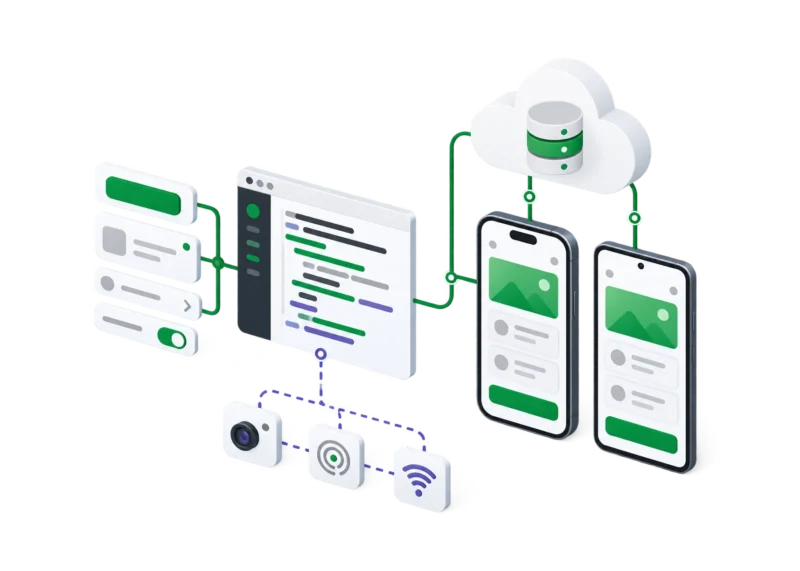
Who cross-platform development is for
-
You need iOS and Android at once
Your audience uses both platforms, and building and maintaining two separate apps is expensive.
-
You have a web product and need a mobile client
The service already runs in the browser: we connect the app to the existing backend through its API.
-
Timeline and budget matter
You need to launch sooner and for less than two separate native builds allow.
What the development includes
-
Choosing the technology
Flutter or React Native — we explain the difference on your project and advise what fits.
-
Interface design
Screens that follow the habits of both platforms: on ready-made components or with a custom design.
-
One codebase for two platforms
The app is built for iOS and Android from a single codebase: one development effort and one to maintain.
-
Connecting the backend
A custom API on Laravel, Firebase or Supabase — or your existing backend through a REST API.
-
Features for your scenario
Sign-in, payments, subscriptions, maps, a catalogue — the feature set is fixed in the estimate before the start.
-
Testing on devices
We test the app on real iOS and Android phones, not only in an emulator.
-
Analytics
We connect event analytics, so you see how users move through the app’s scenarios.
-
Revisions and support
Two or three rounds of revisions during development and a month of support after launch are included in the price.
From brief to launch in four steps
-
01
Brief and choice of technology
We go through the task, the audience and the features and advise Flutter or React Native. Within one or two days after the brief you get an estimate and a plan of stages; once agreed — a contract with a fixed price.
-
02
Design and architecture
We design the screens and agree where the data will live: in Firebase or Supabase, in a custom API or in your existing backend.
-
03
Development and testing
We build the app in short iterations and test it on real iOS and Android devices. Two or three rounds of revisions are included in the price.
-
04
Launch and support
We hand the app over for use, connect analytics and support it for a month. A simple app usually takes 3–6 weeks, one with payments or a catalogue 1.5–3 months.
What we work with
Flutter and React Native stand on equal terms: we choose for the project and the team that will develop it further. Native development in Swift and Kotlin is done on request. Data lives in Firebase or Supabase or in a custom API on Laravel, exchanged through a REST API.
- Flutter
- React Native
- Expo
- TypeScript
- Swift / Kotlin (native)
- Firebase
- Supabase
- Laravel
What our clients say about us
We’re confident that after working with us you’ll leave a positive review here too.
This is where it all started. Since then we've ordered two more websites here and never even looked for another developer. Every time the work is done well and on time. I recommend them to colleagues.


We came back a second time, now with the chamber's own website. I didn't have to explain anything from scratch: they remembered how we work and suggested better options themselves. And regular clients get a discount too.


I expected it to be like other companies, where you wait days for a reply. Instead, they're always available and always get back to me. Even in the evenings and on weekends, which I really appreciated.


I paid exactly what they quoted at the start. When I asked them mid-project to add a page with my students' results, they named the price first and only then did it. No "that wasn't included" at the end. Others never worked that way.


Two days after launch, inquiries from the contact form stopped coming in. I wrote to them on a Saturday, and it was fixed by lunch. The problem was with the hosting, but no one said "that's not on us." They just sorted it out.


I know nothing about websites. They explained everything in plain language, no jargon. Before handing the site over, they showed me how to change the text and photos myself and recorded a video. Now I update everything on my own. Thank you for your patience.

The site went live a year ago, and I still message them about small things: adding partners, posting photos from the celebration. They answer as if they'd delivered it yesterday. Not once have I heard that the contract has ended.


We needed the site before the season started, and the deadline was tight. They promised four weeks and delivered in three and a half. I never had to chase them. Every week they told me what was done. We started the season with the site already live.


Our old website brought in one or two inquiries a month. Three months after the new one launched, we get eight to ten, with no ads. We're now on Google's first page for the searches that matter. The site finally pays for itself.


Frequently asked questions about Flutter and React Native
Answers about choosing between Flutter and React Native, the cost, native development and connecting to an existing service. Did not find yours? Write to us.
Flutter or React Native — which one to choose?
Both give you one codebase for iOS and Android. Flutter draws the interface itself, so the app looks the same on every device and suits a custom, non-standard design well. React Native assembles the interface from the platform’s own elements and is written in TypeScript — handy when the web part of the product is already on React and the team knows the language. For the user there is almost no difference; we make the choice at the brief, for your project.
How much does cross-platform app development cost?
A cross-platform app starts from ₴33,000, with its own backend from ₴53,000. Native development for both platforms starts from ₴59,400: it is effectively two separate apps. The app cost calculator shows a guide figure for your feature set, and the tiers and timelines are on the mobile development page. The exact price is fixed in the contract after the brief.
When is native development needed?
When the app runs into what the device itself can do: complex graphics or games, heavy camera work, external Bluetooth devices, demanding background processes. For most apps — a catalogue, bookings, an account area, delivery, a subscription service — cross-platform is enough. Native development, in Swift and Kotlin, is done on request: it takes longer and costs more, so we advise it only when it is really needed.
Will users notice that the app is cross-platform?
In everyday scenarios — no: the same gestures, smooth scrolling, camera, geolocation, notifications. The difference shows in edge cases — heavy graphics or unusual work with the device hardware; we raise those at the brief, before development starts.
We already have a website or web service — can the app connect to it?
Yes, if the service has an API: the app works with the same data and accounts as the site. If there is no API, or it is not enough, it has to be built first — a separate service, backend and API development.
Can we start with a minimum version?
Yes. A first version with one key scenario lets you test the idea on users without building everything at once — that is MVP development. The code of the first version is not thrown away: the next features are added to it in stages.

Shall we discuss your app?
Tell us what the app should do and whether there is already a web part or a backend — we will advise Flutter or React Native and name the cost and the timeline. No obligation.