
CRM and payment integration services for your website
We connect your website to the services you already use, so orders and leads are no longer copied by hand. CRM integration services, payment and delivery set-up, external APIs — and custom development on a site another team built.
from ₴20,000
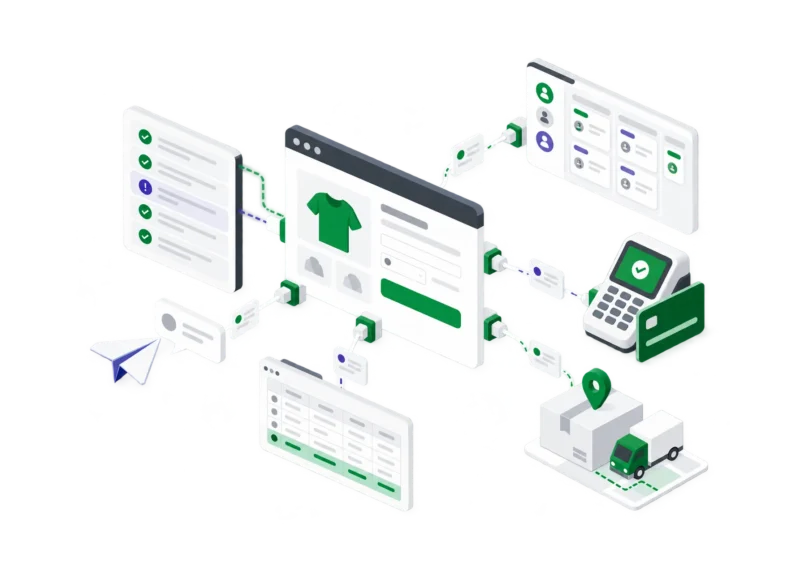
Who needs integrations
-
An online store
Orders, payments and shipments live in separate dashboards, and a manager copies them by hand.
-
A company with a CRM
Leads from website forms land in an inbox and get lost — they should go straight to the CRM and a messenger.
-
A site built by another team
The contractor will not take the change on or is gone: we study the code and add what you need without a rewrite.
The integrations we build
-
CRM
Leads and orders from the website go straight to the CRM you already use — through its API.
-
Online payments
LiqPay, WayForPay, monobank or Stripe: payment on the site, and the payment status returns to the order.
-
Delivery
Nova Poshta and Ukrposhta: the shopper picks a city and a branch at checkout.
-
Product import and export
A supplier price list in CSV, XML or YML: products, prices and stock are updated from the file on a schedule.
-
External APIs and webhooks
We connect third-party services through REST APIs and webhooks — including sign-in with a Google or Apple account.
-
Leads to Telegram and Google Sheets
Website forms send each lead to email, to Telegram and as a row to Google Sheets, so none gets lost.
-
Analytics: GA4 and GTM
Events and conversions in Google Analytics 4 through Tag Manager: leads, calls, store purchases.
-
Log and alerts
Every exchange is written to a log, and an error sends an alert to Telegram or email.
From analysis to launch in four steps
-
01
Analysis and estimate
We find out which data has to go where and read the service’s documentation. For a site built by another team we audit the code first. The scope, the price and the timeline go into the contract.
-
02
Development
We write the data exchange: API requests, handling of responses and errors, the log. Access keys are stored apart from the code.
-
03
Testing in sandbox mode
We run the scenarios on the service’s test keys: an order, a payment, a refund, a failure on the service’s side. You see the result before launch.
-
04
Launch and handover
We switch the integration on for the live site, watch the first exchanges and hand over a guide. One integration usually takes 1–2 weeks; the service accounts and keys stay with you.
What we build integrations with
We write integrations in PHP — for sites on WordPress, WooCommerce, OpenCart and Laravel. Services are connected through REST APIs and webhooks; when an exchange is easier to assemble as a workflow, we use n8n.
- REST API
- Webhooks
- PHP
- Laravel
- WordPress
- WooCommerce
- OpenCart
- n8n
What our clients say about us
We’re confident that after working with us you’ll leave a positive review here too.
This is where it all started. Since then we've ordered two more websites here and never even looked for another developer. Every time the work is done well and on time. I recommend them to colleagues.


We came back a second time, now with the chamber's own website. I didn't have to explain anything from scratch: they remembered how we work and suggested better options themselves. And regular clients get a discount too.


I expected it to be like other companies, where you wait days for a reply. Instead, they're always available and always get back to me. Even in the evenings and on weekends, which I really appreciated.


I paid exactly what they quoted at the start. When I asked them mid-project to add a page with my students' results, they named the price first and only then did it. No "that wasn't included" at the end. Others never worked that way.


Two days after launch, inquiries from the contact form stopped coming in. I wrote to them on a Saturday, and it was fixed by lunch. The problem was with the hosting, but no one said "that's not on us." They just sorted it out.


I know nothing about websites. They explained everything in plain language, no jargon. Before handing the site over, they showed me how to change the text and photos myself and recorded a video. Now I update everything on my own. Thank you for your patience.

The site went live a year ago, and I still message them about small things: adding partners, posting photos from the celebration. They answer as if they'd delivered it yesterday. Not once have I heard that the contract has ended.


We needed the site before the season started, and the deadline was tight. They promised four weeks and delivered in three and a half. I never had to chase them. Every week they told me what was done. We started the season with the site already live.


Our old website brought in one or two inquiries a month. Three months after the new one launched, we get eight to ten, with no ads. We're now on Google's first page for the searches that matter. The site finally pays for itself.


Frequently asked questions about integrations
Answers about the cost and the timeline, services without an API, changes to sites built by other teams and what happens when an exchange stops. Did not find yours? Write to us.
How much does it cost to integrate a website with a CRM or a payment service?
From ₴20,000 for one integration with a service that has an API. The price covers the analysis of the documentation, development, testing in sandbox mode, launch and a guide. The amount depends on the number of systems and on whether data flows one way or both ways; it is fixed in the contract after the analysis. Small changes to a site are done by the hour, as part of technical support.
How long does an integration take?
One integration with a service that has an API usually takes 1–2 weeks. Several systems or a two-way exchange take 3–6 weeks. We name the exact timeline after the analysis and fix it in the contract together with the price.
Do you do custom development on sites built by another team?
Yes. We take on sites built with WordPress and WooCommerce, OpenCart, Laravel and PHP. First we audit the code: we look at how the site is put together and what can be added without breaking what already works. After the audit we name the price and the timeline.
What if the service has no API?
Then we look for another way to exchange data: a scheduled file, a webhook or an email. And if it is your own system that has no API, one can be built — that is a separate service, backend and API development.
How is an integration different from automation with AI agents?
An integration connects two systems by clear rules: an order from the website goes to the CRM, the payment status comes back to the order. When a whole process has to be automated and it includes steps a person does today — reading an email, checking a document, drafting a reply — that is process automation with AI agents.
What happens if an exchange stops or the service changes its API?
Every exchange is written to a log, and an error sends an alert to Telegram or email — a failure is visible at once, not when an order has gone missing. If the service changes its API, we update the integration as a separate task. The service accounts are registered to you, so access to them is always yours.

Shall we discuss your integration?
Tell us what site you have and which services it has to be connected to — we will study their APIs and name the cost and the timeline. No obligation.